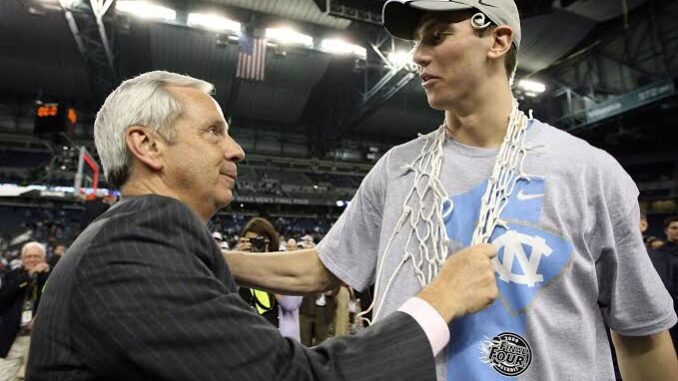
EXCLUSIVE: “Jordan Wasn’t #1” – Roy Williams’ Top 10 Tar Heel List Ignites Firestorm in Carolina Basketball Lore
In a revelation that has sent shockwaves through the college basketball world and ignited the fiercest debate in decades among the Carolina faithful, Hall of Fame former coach Roy Williams has publicly ranked his top ten players from his storied tenure at the University of North Carolina. The list, shared during an intimate alumni fundraiser and subsequently leaked to media outlets, features a seismic, headline-generating decision: **Michael Jordan is not number one.**
The ranking, described by Williams as “the most difficult thing I’ve ever tried to put on paper,” places the immortal, six-time NBA champion and global icon at the **number two spot**. Topping the list, in a move that has divided the Tar Heel nation, is none other than **Tyler Hansbrough**, the 2008 National Player of the Year and the program’s all-time leading scorer.
“This isn’t about the NBA. This is about what they did, for four years, in that Carolina blue jersey, for their teammates, and for me,” Williams stated, preemptively addressing the inevitable controversy. “Michael is the greatest basketball player of all time, period. But if you’re asking me who the greatest *Tar Heel* I ever coached was—the one who embodied every single thing we preached, every single day, for every single minute of his career—it was Tyler. His relentlessness, his improvement, his will to win… it was unprecedented.”
**The List That Lit the Fuse**
The full list, as provided by Williams, is as follows:
1. **Tyler Hansbrough** (2005-2009)
2. **Michael Jordan** (1981-1984)
3. **Antawn Jamison** (1995-1998)
4. **Ty Lawson** (2006-2009)
5. **Sean May** (2002-2005)
6. **Wayne Ellington** (2006-2009)
7. **Harrison Barnes** (2010-2012)
8. **Marcus Paige** (2012-2016)
9. **Sam Perkins** (1980-1984)
10. **Brice Johnson** (2012-2016)
Williams provided brief, pointed rationale for several key placements. He called Hansbrough “the perfect college player” and “the most driven competitor I’ve ever seen.” Of Jordan, he said, “His talent was supernatural. He won us a championship in ‘82 with a shot only he makes. But in my system, for the totality of a college career, others had a more complete impact.”
He notably placed Ty Lawson above Sean May, calling Lawson “the single most impactful offensive engine I ever coached,” and highlighted Harrison Barnes for “carrying the weight of unbelievable hype with absolute class and producing from day one.”
**The Fallout: A Nation Divided**
The reaction across social media, talk radio, and Chapel Hill watering holes has been instantaneous and volcanic.
**Team Hansbrough** supporters cite his record-shattering 2,872 points, his four All-American selections, his relentless work ethic, and his role as the undeniable heartbeat of the 2009 National Championship team. “Roy’s point is exactly right,” argued former teammate Bobby Frasor on a local radio show. “MJ was MJ, but Psycho T *was* Carolina basketball for four straight years. He lived it. He bled it. He *defined* the culture Roy wanted.”
**Team Jordan** loyalists are apoplectic, viewing the list as academic overthinking that borders on blasphemy. “This is insanity. It’s Michael. Freaking. Jordan,” tweeted a prominent UNC alumni account. “The greatest winner in sports history. The guy who put Carolina on the global map. You don’t overcomplicate this. Number one. Period.” Many point out that Jordan’s iconic game-winner to secure the 1982 national championship as a freshman is the single most famous moment in program history.
Other debates rage within the list. The exclusion of legends like **Phil Ford** (whom Williams did not coach) is understood, but the omission of players like **Jerry Stackhouse** or **Rashad McCants** has drawn criticism. The placement of the ultra-efficient but less-dominant Sam Perkins in the top ten over some more recent stars is also a point of contention.
**A Deeper Philosophical Schism**
Beyond the simple rankings, Williams’ list has exposed a fundamental philosophical rift among basketball fans: **What defines greatness in the college game?**
Is it the ceiling of talent and iconic moments, represented by Jordan? Is it the sustained, day-in, day-out dominance and embodiment of a program’s ethos, represented by Hansbrough? Or is it the perfect synthesis of talent and timing, the player most responsible for delivering a championship, represented by Williams’ high rankings for Sean May and Ty Lawson from the 2005 and 2009 title teams?
Sports pundits have seized on this divide. “Roy isn’t ranking careers; he’s ranking *coachability* and *system impact*,” argued one national analyst. “He’s valuing the players who maximized what he wanted to do more than he’s valuing raw, transcendent genius. It’s a coach’s list, not a fan’s list.”
**The Williams Legacy and Intent**
Those close to Williams suggest this list, while genuine, is also a deliberate testament to the culture he spent decades building. By elevating Hansbrough, the ultimate program product, over Jordan, the ultimate basketball phenomenon, he is making a final, powerful statement about what his Carolina program stood for: development, consistency, and team above all.
Whether it settles any debates is profoundly doubtful. If anything, Roy Williams has poured gasoline on the eternal fire of Carolina basketball discourse. He has given the “Hansbrough over Jordan” argument the ultimate credence, ensuring that barstool and Twitter arguments will rage for another generation.
In the end, the only point of unanimous agreement is that the list is profoundly, fascinatingly *Roy*. Defiant of expectation, rooted in a specific brand of loyalty, and designed not to worship at the altar of NBA glory, but to honor the concrete, four-year journey of a college athlete. The Tar Heel family is now irrevocably split into factions, but they are all, passionately, talking about Carolina basketball. And perhaps, for the old coach, that was the point all along.
Leave a Reply